Monday, August 5, 2013

My Week Without Water


It took me a few days to post this so as of right now there is water in my house. I wrote this when there was no water. The water came back after a long fight with the water company but I have a feeling it is going to go out again since they are doing a lot of work in the area. We’ll see. For now please continue and read about life without water.


We haven’t had water at my house for a week now. I thought not having electricity was bad but not having water is way worse. Not having water makes life very hard and very frustrating. You probably don’t realize how important water is to your daily life. I’m here to tell you that, after learning the hard way, water is crucial to your life, and I’m not even talking about drinking water. If you live in a place that has consistent water then your use of water probably never crosses your mind. I know plenty of people do try and be conscious of how much water they are using but it is still there when you need it. For the past week I did not have water when I needed it. The difficulty of life increased significantly.

I can’t just get up and wash my hands or my face and that alone is surprisingly infuriating. Not being able to wash dishes drove me crazy, not being able to shower was getting annoying, but not being able to wash my hands was probably the worst part for me. Uganda isn't very clean so washing your hands is an important part of life especially when you have the cutest but at the same time dirtiest little neighbor children who love to hug and touch you. Hello germs! I wash my hands and my face frequently and not being able to was seriously affecting my usual happy demeanor. I was getting annoyed. Oh wait, I’m still annoyed because we still don’t have water. I’m sitting at a coffee shop right now instead of working from home because at least this place has a working toilet. Let me take a break in my complaining and tell the story.


Catching rain water


I was leaving for Gulu early Thursday morning two weeks ago and as I was leaving the house my housemate said there wasn’t any water. I wasn’t too concerned about it at that point for a few reasons one being that we never have problems with the water and I figured it would come back in a few hours and two because I was leaving for two days and didn’t have to deal with it.

Oh how wrong I was.

I came back from Gulu on Saturday afternoon and the water had just come back. I was glad I was out of town for the lack of water but felt bad that my housemate had to deal with no water. The water was on until Tuesday. On Tuesday water stopped flowing from the kitchen sink and the outside tap. We still had water coming from all the other faucets because they are also connected to our reserve tank. We could shower, wash our hands, brush our teeth, etc which was great but by Thursday we were starting to run out of dishes because we hadn’t been washing them. On Friday we decided to have our cleaning lady come because she hadn’t come in two weeks and the house was really dirty and we needed our clothes washed. She used the water from the shower to clean the house and to wash the clothes. She had to use a lot of water and that’s when it happened. Saturday morning we were totally out of water. No more water in the reserve tank. We used it all up. The house was dry. We were not happy. However, at the top of our street there was a loose hose that the neighbors were gathering water from. We started filling up buckets and cans from there. We stored the water in the house so we could flush the toilets, bath, wash some dishes, etc. It wasn't easy but at least we had some water to use.

Catching rain water to flush the toilets with


On Monday the people who live in the house that the hose was coming from realized that it was their water the entire neighborhood was using and, understandably, they blocked it off. At this point we had absolutely no access to water. We couldn’t even fill buckets anymore. Things were getting really tough. I was extremely frustrated and had no desire to be at home. I work out at my friend’s house four mornings a week so I started showering there after working out.

Emily, my housemate, getting water 

from the hose up the street. Thanks neighbors!

This entire time we’ve been calling the water company and complaining, but they were less than helpful. On Wednesday afternoon I left work early so I could deal with the water situation. I called the water company for the 10th time but this time I couldn’t control my anger and I screamed at the woman on the other end. I started off the conversation calm but then she asked me a really stupid question and I lost it. After I told her we still don’t have water she said, “It says here they fixed the problem. Why would it say that?” So after that comment I was no longer able to remain calm. Long story short I was put in contact with the person who was working on the project. A man was up the street working on the pipes going to the neighbor’s house so I talked to him and he said they would not be able to work on our pipes until the next day (today). As I type this I have no idea if there is water at the house. I saw them working early this morning but then didn’t see anyone working later in the morning. I have little faith we will have water today.

This has been one of the most frustrating experiences, and I am continually surprised at how hard life without water is. I always knew not having running water was a pain and that access to water is a huge issue in the developing world but I never really understood how hard life without water is until I experienced it. So while I am not happy we haven’t had water in weeks I gained a lot of perspective that I would not have had otherwise.

Uganda has taught me to be thankful for things I never even thought to be thankful for before I lived here. Water. Electricity. Street lights. Paved roads. City trash pickup. Good city planning. These few things significantly improve quality of life. We usually have water and electricity. Street lights are rare but exist on main roads. The main roads are also paved but most roads including the roads around my house are not. Also many of the paved roads are so riddled with potholes it doesn’t seem paved. I still haven’t decided if a paved road with tons of potholes is really better than a flat dirt road. I go back and forth. 
Anyway, now as I travel around the city and see people everywhere washing dishes in large buckets of water I understand how difficult that task really is and I think about how much easier that person’s life would be if they had access to running water. The daily tasks of Ugandan families living without direct access to running water would decrease significantly. From the looks of things kids spend half their day fetching water from nearby wells and other types of water sources. Uganda is growing rapidly but just as so many other developing countries it still lacks very basic infrastructure like running water and consistent electricity. I am so thankful I am able to live in a house that (usually) has water and electricity. 

Tuesday, July 23, 2013

Upcountry


My trip to Gulu this past weekend was a bouncy and exhausting one but one that is well worth the bumpy bus rides, lack of electricity, icy cold showers, and long days. Gulu is the second largest city in Uganda. It is in Northern Uganda about 338.8 kilometers (210.5 miles) from Kampala a ride that would take approximately 3.5 hours on US roads but takes anywhere from 5-7 hours depending on traffic and road construction. The road to Gulu is not great to say the least. It is riddle with pot holes and in some parts the pavement has been worn down to a small strip in the middle of the road barely big enough for one vehicle. There is construction being done currently which is promising for the future but a pain right now.

Once you finally make it to Gulu it is quite lovely. It is small town that has come a long way in a short time since the years of LRA control and general political strife and civil war in Uganda. A friend just shared his experiences of Gulu in 2006 with me and explained it as having little infrastructure and one restaurant with C+ food. Now Gulu has many restaurants and some even have A+ food (A+ for Uganda that is which is an entirely different rating scale). When I arrived in Gulu I hopped off the bus and headed to a popular restaurant to enjoy their delicious brick oven pizzas. After a late lunch I made my way to the girl’s home HALO supports. I rode a boda (motorcycle taxi) and thoroughly enjoyed the ride. The air is so much fresher in Gulu and I found myself sucking it in trying to clean out my lungs of the gross Kampala fumes. The ride was also quiet which is such a treat for me. In Kampala I am assaulted daily by noises from all. Such is big city life.
Ahhhh, peace


When I got to the girl’s home I was greeted with smiling faces running towards me bombarding me with hugs. It was so great to see those girls again. 


We spent the evening doing art as we always do and taking pictures. We had a delicious traditional Ugandan dinner prepared by the girls. 


It was a lovely evening but I was ready to turn in early after the long bus ride. I feel asleep immediately (which never happens to me) but woke up in the middle of the night to the rain pounding on the tin roof. Despite being woken up I was happy for the rain because it brought the temperatures down and made everything less dusty. It hasn’t rained in Kampala in months and the dryness is getting to be too much. The plants on the side of the road are no longer green but have a thick coating of reddish brown dust stirred up from passing vehicles. It was nice to smell the rain again.

In Kampala

Poor plant, it was once green.


Dust Prints


The girls were in school all day Friday so I did some work and charged my electronics at the same restaurant I went to the day before. I ran into some people I know so I ate breakfast with them and we spent some time catching up. It was nice to see them at breakfast because I never really have time to socialize with the people I know in Gulu since I only go for a few days and I spend them working. That afternoon I went to see our girls who are in boarding school. The school they attend is called Restore Leadership Academy. It is a great school inspired by the visionary Bob Goff and run by a few people who I am proud to say are my friends. Check out their website for more information. http://www.restoreinternational.org/


Restore Girls
The view from the school

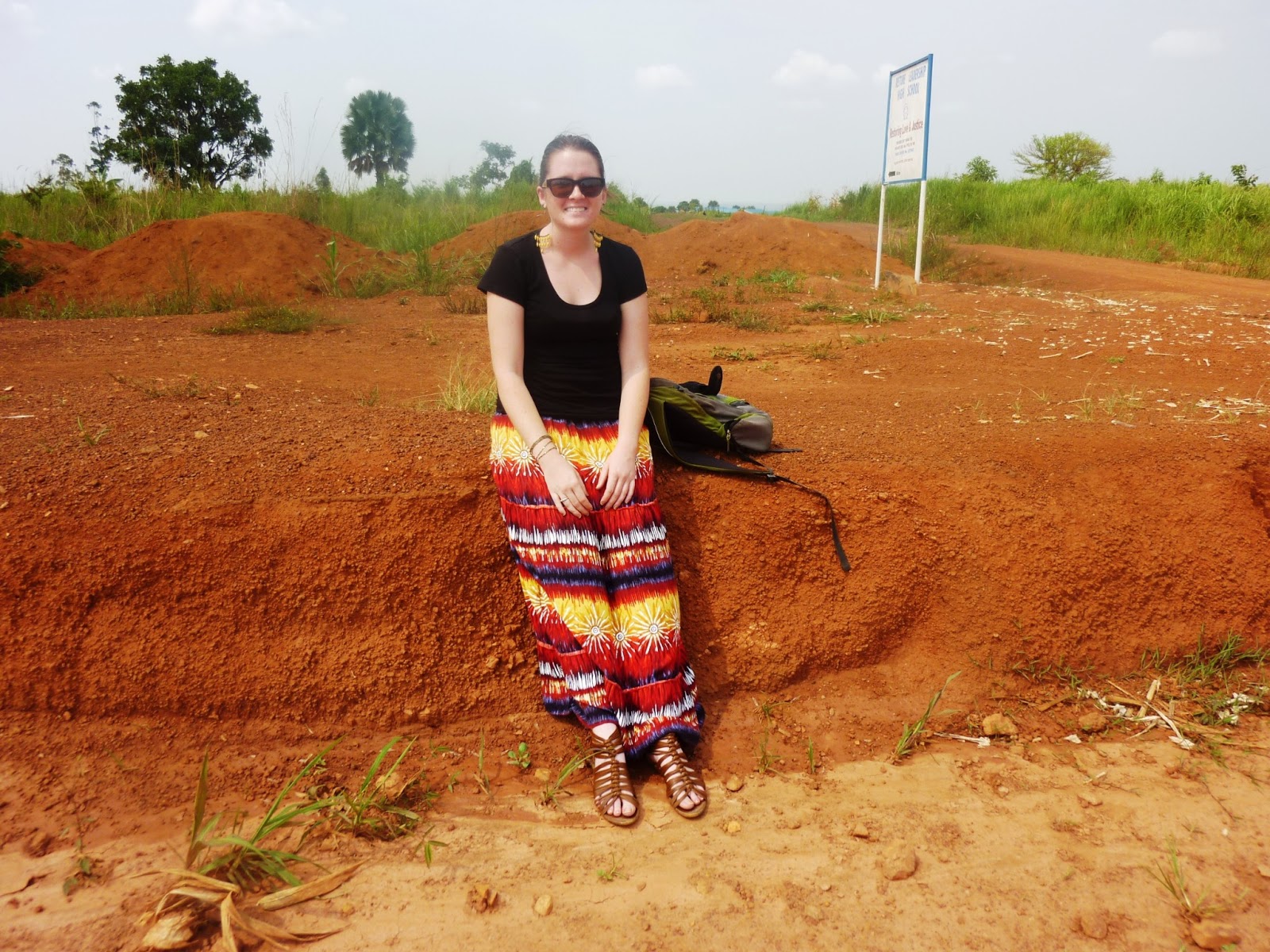
Me waiting on the side of Juba Rd, the road that goes from Uganda to Juba, South Sudan, for a transportation opportunity. A boda eventually drove by.


I only had an hour with the girls since they had to get back to class but we had a good time catching up.
After visiting Restore I had a meeting with the mentors who manage the Gulu home. I was so happy to hear everything is going really well and they didn’t have any major problems to discuss. Finally the girls got home from school around 5pm. I did some art with the girls who were not busy preparing dinner. We had another delicious dinner and after eating the girls treated us to a few performances. First the girls performed a danced they choreographed themselves. Then they did a news broadcast that I really loved. The girls wrote stories about what has been going on in Gulu Girls home and reported them like they were newscasters. One girl read the headlines then the other girls read the in depth stories. It was adorable and I actually learned a lot about what the girls have been up to! To end the night we watched Shrek on a laptop. The girls loved the movie.

The Neighbors 

The Neighborhood


Main water tap at the house


I left early the next morning for Kampala. I was able to catch a ride with someone I’ve never meet but heard about many times. His name his John and he worked for Restore International in Uganda for five years. He left last May about a week before I came to Uganda to attend law school. He was back in Uganda visiting and working with Restore. He shared many stories with us on the ride down to Kampala and I really enjoyed hearing about what Gulu was like six years ago. Six years may not seem like a long time to you but a whole lot can change in six years in Africa. Gulu has definitely changed a lot in the past six years.
I am always happy to be back in Kampala because I am not much of a small town girl, but I always wish I could spend more time with the girls in Gulu. 

Friday, July 19, 2013

HALO Homes - Uganda Style


HALO has five homes in Uganda and each home has a name and its own personality. Four homes are in Kampala and the fifth is in Gulu which is a town in Northern Uganda. The homes are simply named by the area of the city they’re located in. The greater Kampala area is broken down by districts and parishes. Each district and parish has a name. Our homes are located in three different districts but they are only about 20 minutes from each other. Each home has a unique vibe and I’d like to talk briefly about each home.

All of the Kampala homes are ranch style houses that are within a walled off compound. The yards are medium sized but with enough room for the kids to run around and play. The houses typically have four to five bedrooms, a small kitchen, one bathroom, and a storage closet. Each house also has a separate bedroom outside as well as an outdoor bathroom and kitchen which are standard features for houses in Uganda.

Mengo Home – The Mengo home is an all girls home with 22 girls ages 9-18. About half of the girls are 13 or younger so the home has a very youthful feel. The girls love to play with each other so they are always playing games, dancing, and hanging out as a group. The majority of the Mengo girls enjoy dancing and singing. They choreograph their own dances and hold practices every week. The Bukesa boys, from the Bukesa home which is a short five minute walk away, usually join the girls for dance practice. Overall the Mengo home is a playful home with the sweetest girls who love a good giggle. It is always a joy to spend time with the Mengo girls.


The girls dancing and singing


Sisterly Love


Bukesa Home – The Bukesa home is a busy place filled with 21 rambunctious boys who love to have fun. Fun and silliness is the unofficial motto of Bukesa home. These boys love to run, jump, skip, flip, and fly around. It is near impossible to get one of the younger ones to sit down with you and concentrate for more than five minutes. They are always finding interesting ways of entertaining themselves. Sometimes I find them chasing the chickens around the yard. Sometimes half of them are up a tree doing who knows what. Other times they are all working together to take apart and repair old electronics they’ve found. I never know what I am getting myself into when I visit Bukesa home.


Unloading food from the truck

I wasn't kidding...Nathan and the chicken he caught

Karim! How did you grow your hair so long?

Typical. In a tree.


Lungujja Home – The Lungujja home is a home for girls who were involved in prostitution. The girls are older and more serious than the Mengo girls. They are pretty typical teenager girls. They’re into clothes, music, and hanging out with their friends. The Lungujja girls are more interested in doing well in school and learning practical skills than playing and having fun. In their free time they like to sew, dance, and to spend time relaxing and chatting with each other. I deeply admire the strength and courage these girls have. They are learning how overcome their pasts and to be strong confident young woman who look forward to their future possibilities.


Hanging out

Art

School work


Makerere Home – The Makerere home is a home for older boys who were living on the streets. All but two of the boys in this home are older than 15 and all of them have had very hard lives. Due to the nature of their childhoods the Makerere boys are tough kids who do not like to show emotion. They are not really into playing as much as the Bukesa and Mengo kids are. Most of the boys are in secondary school so they spend a lot of time focused on school and doing homework. Despite their rough exterior they are really sweet boys who love deeply. They enjoy playing soccer and making crafts like beaded bracelets.


Sadam's application for school prefect


Gulu Girls Home – The Gulu home in Northern Uganda is quite different from the homes in Kampala mostly because of the cultural and structural differences between the two places. The Gulu home is in what we in Uganda call the bush or the village. The home has a lot more land than the Kampala homes and instead of being located in a city it is located in a rural farming area. The kids do not encounter the same distractions as the Kampala kids do because there are none of the features of a large cosmopolitan city. Gulu is a quiet and small town that has far less infrastructure than Kampala. The girls are very well behaved and the home operates in peaceful unity. The girls are very sweet and they love to perform plays and dances. They keep themselves busy each week by organizing game nights, debates, and intentional family time where they share and the mentors teach lessons. They also enjoy taking care of their garden. It is always a treat to visit the Gulu girls. 


Friday, July 12, 2013

Kids Say the Darndest Things

Let's start off with this cuteness....


From left to right we have Ibra, Abudul, and Karim. These three are always hanging out with each other so the other day I asked each one why they like the other two. The first kid I asked was Ibra. Ibra is never in to answering my questions so in true form he just said "because I love them" using a very obviously-that-is-the-reason-mary-why-are-you-asking-me-this tone of voice. Of course I probed him a bit more and tried to get him to tell me what it is about Abudul and Karim that makes him love them. This is what he finally said


Ibra said about Karim, “I like his skills in somersaulting.”

Ibra said, “I like his dancing” about Abudul.

These three boys really enjoy gymnastics. They are always flipping, cartwheeling, hand-standing, and so on. They refer to these activities as somersaulting. 

Here is what the other two said about each other...

Abudul said about Ibra, “There are many things. He likes playing. He likes to be with his brothers or friends. He goes to school and does not miss. He likes to be with his friends, play with them. He likes to go to the parties (at school).”

I think my favorite reason Abudul loves Ibra is that he goes to school and doesn't skip! What a great reason to be friends with someone. 


Abudul said, “He is a somersault boy. He likes to read story books. He likes to talk with us and the uncles. He likes dancing. He is a boy. We are good friends” about Karim.


My favorite reason Abudul gave for liking Karim is that he is a boy. 

Karim said he likes Ibra because “Ibra likes to eat, play, fight, study, and he likes jokes.”

Karim said “Abudul like to play so much! He likes jokes. He likes to fight, and to somersault. Abudul is a hard working boy and so is Ibra.”

Of course Karim means play fight when he says he likes the boys because they like to fight. 

These boys are in the Bukesa home which is an all boys home. All of the boys in the home consider themselves brothers to the rest of the boys. They are one big family and they are all friends but naturally each child has one or two brothers that he is closer to. Karim, Abudul, and Ibra are very close and now you know why they love to spend time each other.

Hopefully this entry will turn in to a series of entries and I will share pictures of kids and the things they say!


Tuesday, July 9, 2013

How HALO Rocks it in UG


I came to realize that many of you probably don’t fully understand how HALO operates in Uganda so I thought I’d take some time to explain our system because it’s actually pretty cool.

One of the most important aspects of HALO UG (Uganda) is our partnership with the local nonprofit Cornerstone Development Africa, more commonly referred to as Cornerstone. Cornerstone has been operating in Uganda for 30 years. They are deeply connected to the country. Cornerstone’s main program is their schools. The Ugandan school system is quite different from the American system. Without getting in to too much detail the Uganda system works like this…primary school (levels 1-7), ordinary level secondary school (levels 1-4), advanced level secondary school (levels 5-6). Not everyone goes to advanced level secondary school. Cornerstone runs advanced level schools for boys and girls. The Cornerstone schools are always in the top 10 best schools in the country and many of their alumni go on to play important roles in Uganda (some are members of parliament and part of the local governments). HALO partnered with Cornerstone because of their deep connection to many communities in Uganda, their vast knowledge of Uganda, experience working as a nonprofit and working with other nonprofits, and their values and organizational integrity. It has been a very fruitful and productive partnership for both organizations for the past four years.

As the HALO Ambassador in Uganda I work very closely with Cornerstone. My office, the HALO field coordinator’s office, and the resettlement coordinator’s office all reside within the very large Cornerstone head office located in the heart of Kampala (Uganda’s capital). We work very closely with the Cornerstone staff to ensure a strong partnership.

HALO has five youth homes in Uganda. These homes are directly run by mentors or as we call them in Uganda, Aunties and Uncles. The mentors are graduates of the Cornerstone schools. The mentors are hand selected by the Cornerstone staff (mainly their alumni coordinators and the head mentor) with the approval of HALO staff. The mentors live in the youth homes for three to four years while they are in university. The mentors are held to very high standards and are given a great deal of support from HALO and Cornerstone staff. They receive training throughout the year in the form of weekly meetings, and occasional guest speakers and leadership conferences. 

The nurse who tends to our children giving a lesson on first aid to the mentors


The mentors are the ones responsible for making sure the kids go to school every day, eat three meals a day, receive medical care when necessary, and are loved and cared for. We could not do this without our Aunties and Uncles. They pour themselves in to the HALO homes and we are so thankful for their compassionate souls and their commitment to the children and to HALO. HALO would not function in Uganda without our mentors.

Me and Uncle John at community service

Aunt Harriet and Aunt Teddy of Lungujja home giving directions for community service


HALO also could not function without our field coordinator and resettlement coordinator. Asiimwe, the field coordinator, is a passionate and caring individual who is sharp with numbers and never lets unexplained costs slip by him. Asiimwe is HALO’s accountant in Uganda, but he is so much more than that. Asiimwe cares deeply for all the HALO children. I seek his advice daily on all sorts of issues. Asiimwe helps me make informed and culturally appropriate decisions in regards to HALO work and my own life. He negotiates the rental contracts for all the HALO homes (we rent four of the five of our homes in Uganda) and he even negotiated the rental contract for the house I live in. He frequently visits and checks up on the HALO kids who are sponsored in school but do not live in a HALO home. He makes sure the mentors are aware of their homes financial situation and he is great at reminding us all of the financial implications of our program decisions. HALO Uganda would be fumbling around in the dark without the guiding light that is Asiimwe.

Me and Asiimwe rocking our HALO t-shirts at community service 

We recently hired a new resettlement coordinator and she is already a rock star. Molly was in the Mengo Home before HALO even worked in Uganda. At this time Mengo Home was not well financed and they could not pay for her upper level secondary education. Molly did not give up though. She is an excellent dancer. She dances all the traditional Uganda dances so she joined a dance troop and started dancing and weddings and other events. She paid her own way through upper level secondary. Then she continued to work and support herself through vocational training school. Now she works part time for Cornerstone and part time for HALO. Since she shares a similar background as many of the HALO kids she really understands their troubles and is able to connect with them. It is Molly’s responsibility to prepare our kids to leave the home. She starts talking to the kids up to if not more than a year in advanced. Molly’s ability to communicate with the kids is a priceless addition to HALO UG.

Then there is me.

I am responsible for overseeing HALO’s programs here and I serve as the liaison between the US and UG. I write monthly home updates and keep our HALO US branches stocked with pictures, stories, and information from the kids and program in Uganda. I manage the scholarship program. I facilitate individual and group art projects with the HALO youth. I spend a few evenings a week hanging out with the kids doing various things. Sometimes I just sit on the couch and wait for them to come talk to me while other times I arrange games, projects, or seek out specific kids to check up on. I also strategize, brainstorm, and work to make our programs the best they can possibly be!


While we all have different job descriptions and various responsibilities we really work as a team. I could not do my job without my coworkers in the US and Uganda.

GO TEAM HALO! 

Saturday, March 9, 2013

Food

Food, food, food! I struggle so much with food in this country! I am not a fan of the local fare and I can barely put two things together to make a decent meal myself. I never thought I was bad at cooking until I came here and I am a mess. There is definitely less available to work with but I still have access to plenty of foods that I could make a meal from. I think my main problem with cooking is that all the things I usually made for myself in college are things that aren't available here. I lived off sandwiches and canned soup in college. Lunch meat is available but its not the same and it is expensive. There is no canned soup to be seen. I could make soup and I made a lentil soup once but I'd rather just buy a can. I have managed to put together some decent tasting dinners, but I still find it hard to motivate myself to cook. Hopefully after more time here I will learn some tricks of cooking in foreign countries. For now I'd like to share about Ugandan food. I do some freelance writing for a website about living in Kampala - http://www.livinginkampala.com/
and this is the article I just finished about local food.


Depending on what situation you are in when eating local food you will be served different types of foods. This article will give you a general review of the majority of the foods you are likely to encounter during your various dining experiences. You will never be at a restaurant or house where all the foods mentioned are available. Furthermore, I will only cover food you will encounter in the Kampala area. During you travels around Uganda you might see or eat food that is not mentioned here. The different regions of Uganda have different specialties.

The local food in Kampala is generally good but can leave the tastes buds wanting. The main staples of meals are starches. The main starches include rice, matooke, posho, and potatoes and will be referred to as the “food” portion of the meal.

The rice in Uganda is standard white rice. Brown rice is not served in Ugandan cooking and is even hard to find at specialty food stores. Matooke is boiled and mashed green bananas. Posho is the local name for a food found all over the African continent and around the world. Posho (or ugali in some parts) is water and maize flour boiled and mashed together until it is a dough like consistency. Potatoes here are your standard potatoes but are usually referred to as Irish.

Food will always be accompanied by one or maybe even two sauces. Sauces are made of beans, peas, groundnuts, and/or meat. The meat sauce is a thin salty broth like sauce made with either goat or beef combined with a few vegetables. The bean and pea sauces are made by boiling dried beans or peas and adding in a few vegetables and a lot of salt. Of all the sauces peas are my favorites, beans are a close second, I’d rather not eat the groundnut sauce, and I do not eat the meat sauce. Vegetables are referred to as spices. The only other spice used in most Ugandan cooking is salt and occasionally a tiny bit of red curry powder. From my experiences I’ve learned that many Ugandans think the saltier the food the better it is. I have no problem with salty foods but I do enjoy more of a variety of spices in my food that I cannot find in traditional Ugandan cooking.

You will almost always be served a side dish with your main starch and sauce. Potential side dishes include:

·        * Greens which can be either kale or some other leafy green like amaranth, nakati, or borr. Greens are boiled and served plain.
·         * Cabbage which is served boiled and salted
·         * Steamed vegetables like carrots, eggplant, and tomatoes
·         * Fresh avocado
·         * Pumpkin
·         * Sweet potatoes
·         * Baked/fried cassava
·         * Baked/fried yam

Dessert

Dessert is not to be expected at most dining occasions in Uganda. I have only ever been served dessert at special events. The most common dessert is fruit like bananas, pineapple, mango, jack fruit, papaya, and passion fruit. At special events like conferences, weddings, and graduation parties the host will most likely provide cake. Most of the cake I’ve had at events in Uganda is relatively dry and not as sweet as I am used to. Many cakes are made with raisins which I’ve never really understood. Other types of desserts like cookies, different types of cakes, ice cream, brownies, etc can be found at stores and restaurants around the city but rarely in a Ugandan home or restaurant.

Street Food/Snacks

Street food is an entirely different category of food in Uganda. You will almost never be served food you can get on the street in a home or restaurant. Street food is also a risky choice. I have eaten street food and not gotten sick, but I know plenty of people who have eaten street food and gotten very sick. That being said…proceed at your own risk. Street food is also similar to the western version of snack food. Food you might see on the streets of Kampala includes:

·     *  Chapatti – similar to a tortilla chapatti is made with flour, water, salt, and lightly fried in oil
          *  Kikimando – beans and chapatti
·      *  Rolex – chapatti with fried egg wrapped up like a burrito
·      * Meat skewers – various meats (chicken, beef, liver) on a stick, cooked on a charcoal grill
·      * Kabalagala - fried banana pancakes
·      * Mandazi - Sweet dough balls similar to doughnuts but not as sweet and a bit chewier
·      * Samosas – cowpeas or beef wrapped in dough and fried
·      *   Groundnuts (gnuts) – roasted and salted peanuts

Rolex is probably my favorite street food. They are filling and good. Sometimes they are too greasy but this is one food I find myself craving in Kampala. Kabalagala are also good but only when they are fresh. Once they’ve been out of the fryer for more than twenty minutes they become chewy and lose their good taste. I have yet to try a meat stick but word is they can be really good. Be careful though because the liver often looks the same as chicken so be sure to clarify what type of meat you’re getting.

Although not my favorite cuisine Ugandan food is good and absolutely worth a try if you are just traveling through.